

from the original Inner Compass Research Institute SSRI survey full report by Nicolas Badre, David Cohen, Eric Geier; Substack Piece by ICRI
Antidepressants are prescribed to roughly one in six adults in the United States, including one in five women, and an estimated one in three Americans has taken them at some point in their life. Among these medications, selective serotonin reuptake inhibitors (SSRIs), such as sertraline, escitalopram, and fluoxetine, are the most widely prescribed. While SSRIs have been FDA-approved since the late 1980s, their astounding increase in use over recent decades has triggered deeper scrutiny and brought more extensive information about their side effects. A report led by the Inner Compass Research Institute (ICRI) investigates patient perspectives on informed consent among a national sample of U.S. adults who have been prescribed SSRIs.
Informed consent is essential for patient autonomy to exist. In the United States, many states require physicians to ensure patients are suitably informed of “all perils bearing significance.” Yet in contemporary psychiatric practice, this standard is hard to measure due to the privacy of medical treatment and a lack of federal requirements for written consent. Without regulations for robust patient education, enforcing these rights remains a reactive process; one that relies on lawsuits following patient harm.
The ambiguity of guidelines of informed consent might create a pocket of unfamiliarity among SSRI-users about the potential risks and adverse effects, which is studied in a new report, titled “Are You Adequately Informed: A Survey of Patient Recall and Preferences Concerning SSRI Side Effect Information.”
True informed consent supports autonomy, reduces regret or harm, and aligns care with patient values. Understanding the existing deficiencies could inform better tools, training, and standards, as well as increase overall patient satisfaction. SSRI users have made clear that they would appreciate awareness of potential negative effects of SSRI medications, whether that information is gathered through informed consent from prescribers or other methods.
What Does Previous Research Say?
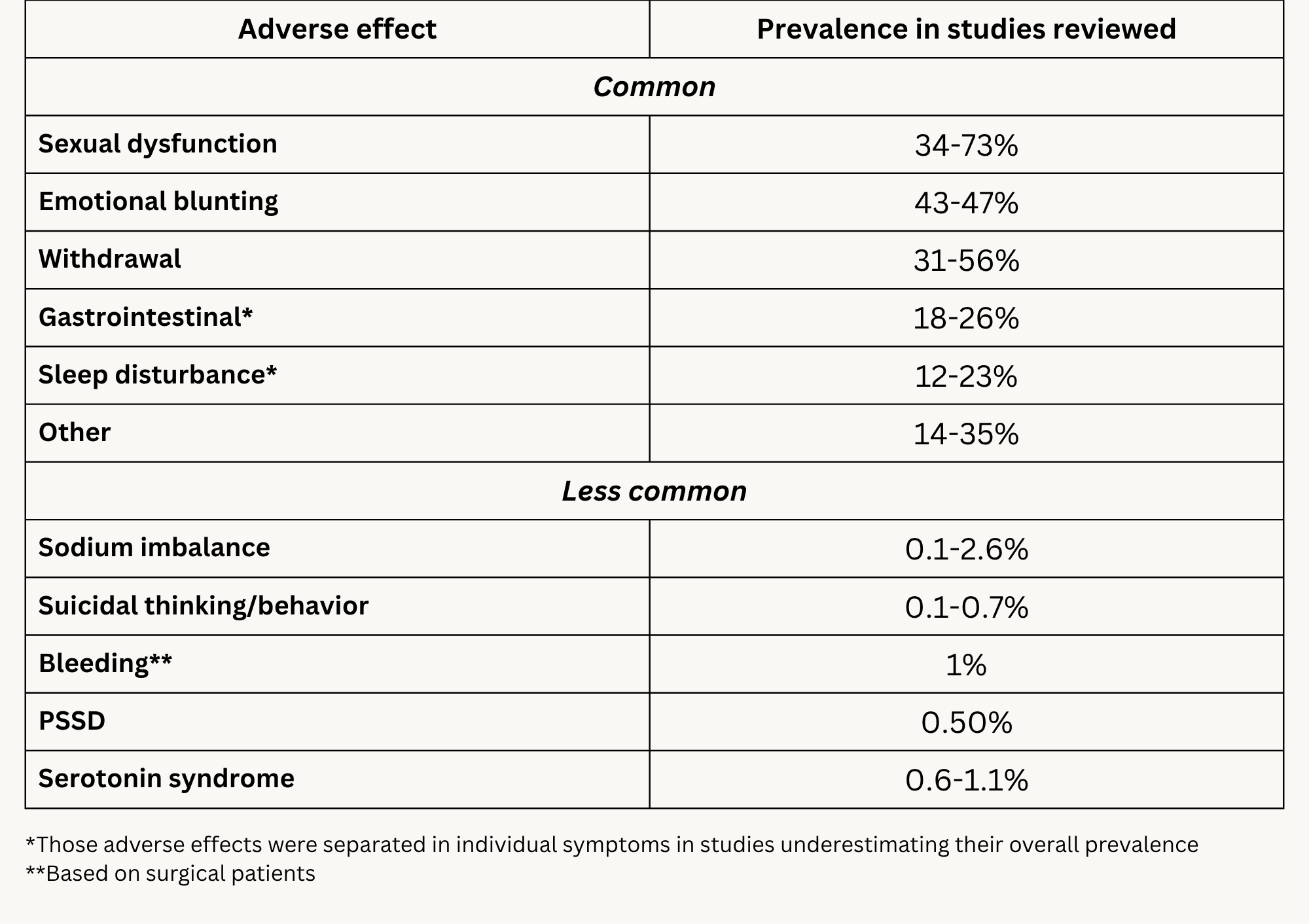
In Inner Compass Research Institute’s recent report, the researchers reviewed the current research published on “side effects”1 of the most used antidepressants: SSRIs. The known rates of the adverse effects are listed here by type and commonness.
Please note that “PSSD” refers to Post-SSRI Sexual Dysfunction which is defined by significant sexual adverse effects that continue even after someone stops taking the medication, rather than returning to a previous level of sexual functioning. This is typically defined by severe features such as absence of sensation in the genitals, complete loss of libido or pleasureless orgasms, and even emotional features such as emotional blunting.)
Although the prevalence available in the research is noted at 0.5%, textbooks for psychiatry often only note broad “sexual dysfunction” as an umbrella adverse effect, including everything from minor symptoms to what we would typically define as PSSD.
These available prevalence rates are in stark contrast to what is currently taught to psychiatrists. A leading recent Textbook of Psychopharmacology mentions many adverse effects as rare, very rare, possibly due to confounders, and transient, but gives no numbers.
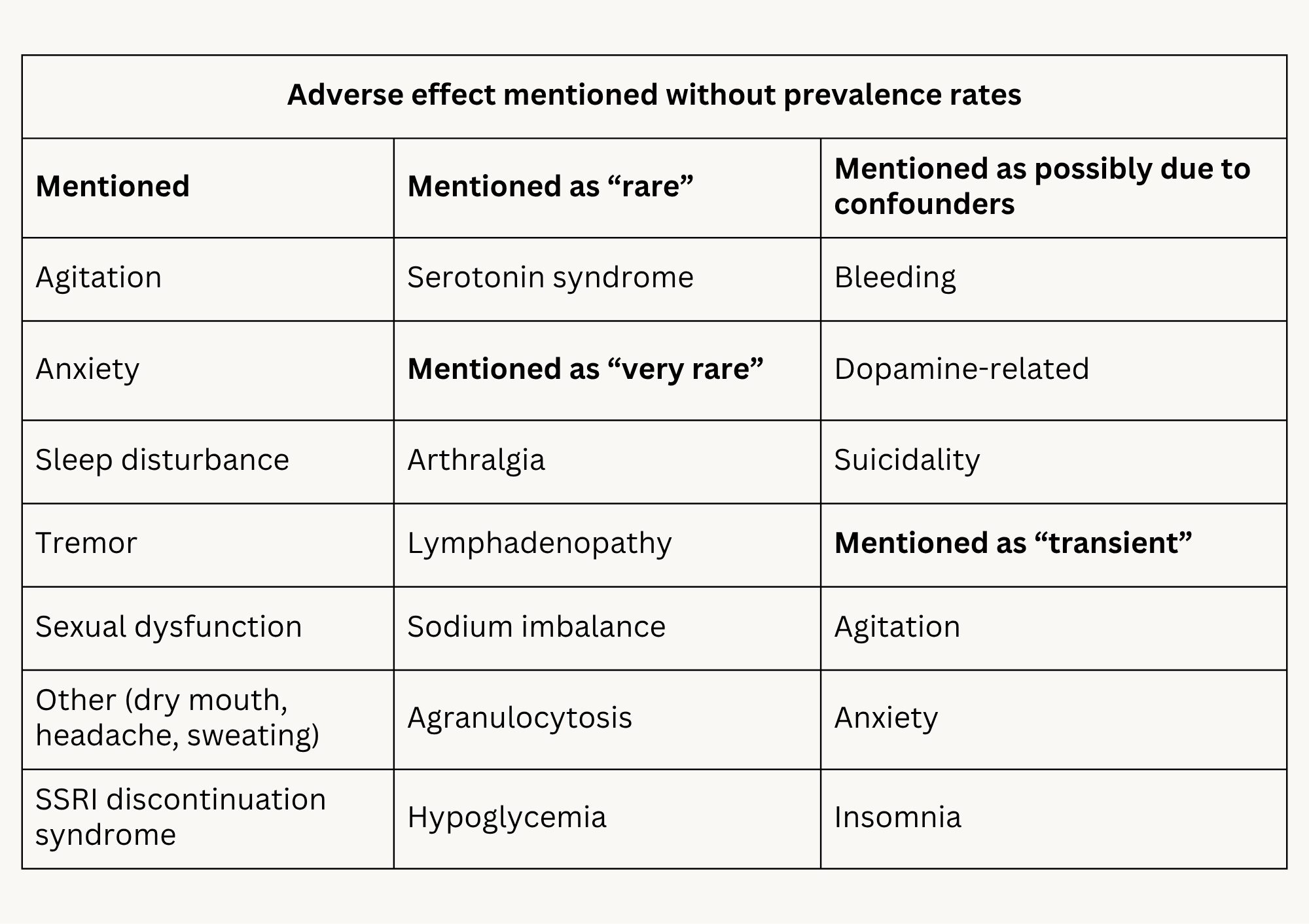
The ICRI literature review suggests a disconnect between the statistical reality of SSRI adverse effects and what is presented in medical education. While the data reveal that rates of adverse effects like sexual dysfunction (34-73%), emotional blunting (43-47%), and withdrawal (31-56%) are frequent, texts minimize these risks as “rare,” “transient,” or the result of confounders. This suggests to prescribers that the adverse effects are brief, uncommon, or due to unknown influencing factors.
This discrepancy suggests that the failure of informed consent is not just a clinical oversight but an educational feature; psychiatrists are being trained to underestimate the toxicity of the tools they use.
What Were Patients Told?
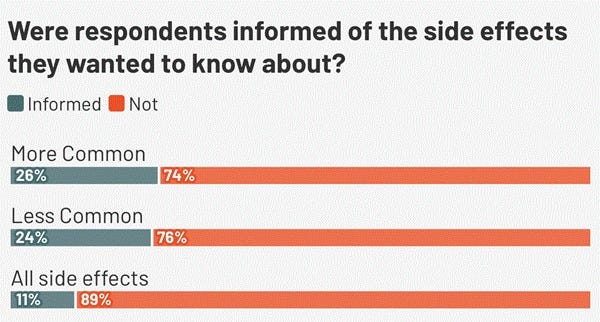
The ICRI project surveyed 1,260 individuals prescribed SSRIs and found zero of the 11 potential adverse effects had a majority of respondents who reported that they were educated about them. More respondents reported being uninformed than informed in every category, and nearly 1 in 3 people reported that none of the severe, but less common, adverse possibilities were reviewed with them.
Sleep was among common adverse effects that were the most reviewed (49%), and the least was SSRI withdrawal (30%), with 14% of respondents recalling that no common adverse effects were reviewed with them.
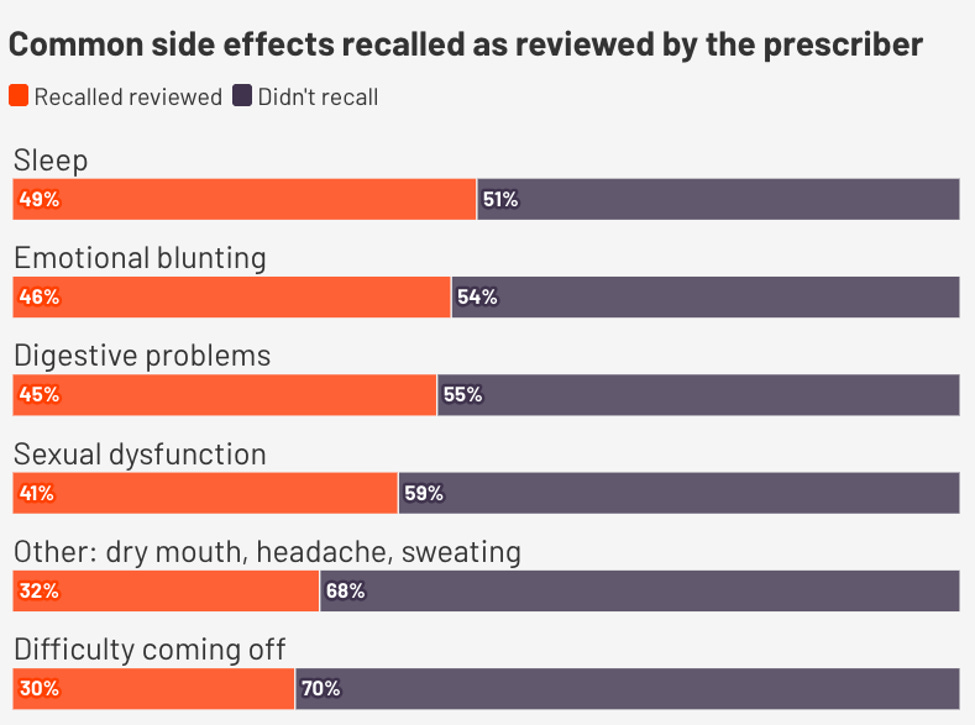
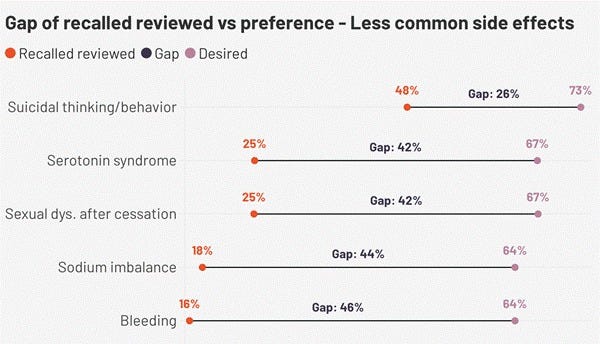
In the category of less common adverse effects, respondents noted their doctors reviewed suicidal thinking and behavior the most (48%), sodium imbalance the least (16%), and 30% of respondents recalled that none were reviewed with them.
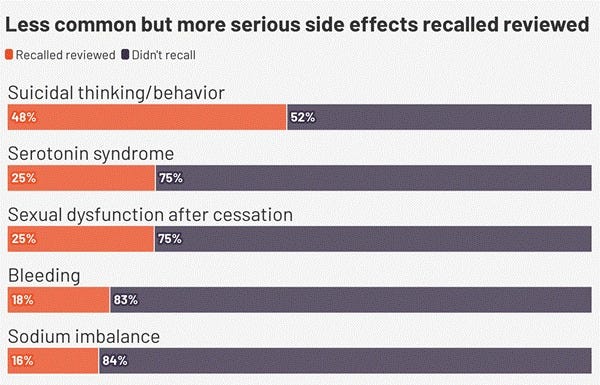
Only 1% of respondents recalled all 11 side effects reviewed with them. 11% of respondents recalled having no side effects reviewed with them.
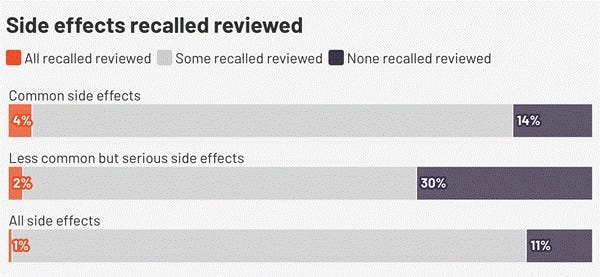
The report’s data suggests a troubling failure in standard psychiatric practice: the “informed” aspect of consent appears largely absent for SSRI prescriptions.
Is Ignorance Bliss?
Through this ICI Research survey of 1,260 people prescribed SSRIs, respondents were informed of the available prevalence rates of common and uncommon adverse effects. Respondents were then asked about their preferences of being informed about each possible adverse effect. The statistical analysis revealed a significant desire to be informed about the potential adverse effects of SSRIs.
According to the data, 69% of respondents reported wanting to be informed about sexual dysfunction and emotional blunting and 73% reported wanting to be informed about suicidal thinking and behavior. Though these were the possible adverse effects with the highest rates of preference for being informed, other common and less common effects were still rated by the majority as something they would want to be informed about prior to being prescribed the medication.
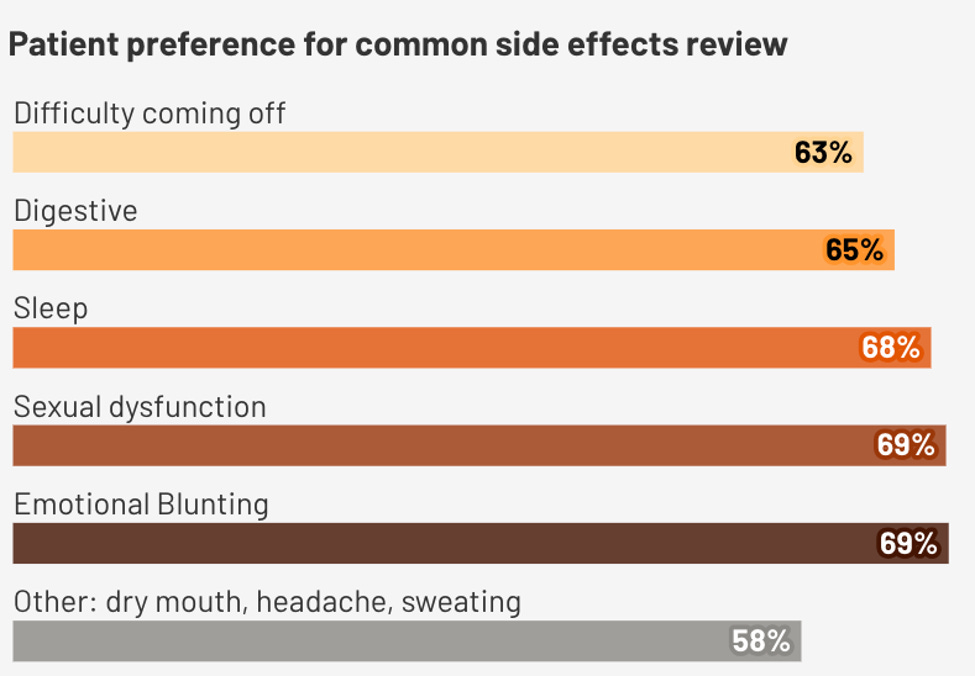
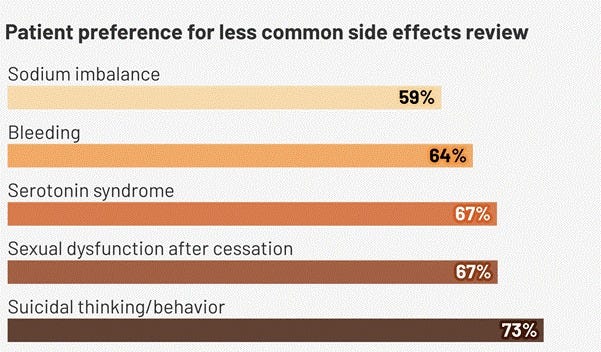
The findings from the ICI Research report contradict the notion that patients just want medications without adequate informed consent. Instead, the data reveals that patients are interested in comprehensive transparency of the evidence of the risks.
In fact, the highly reported desire to understand quality-of-life impacts of emotional blunting and sexual dysfunction implies that patients view these side effects as critical factors in their decision-making.
The Information Gap
The research report sought to better understand the “information gap” of consent: the difference between the adverse effects that patients recall being told about and the ones that they retrospectively stated that they wished to know. The results reveal a statistically significant disconnect for every single adverse effect measured. This statistical significance prompts us to look at the magnitude of difference between reported recall of informed consent, and the respondent’s preferences.
In the grouping of common side effects, the widest gap was found regarding the difficulty of stopping the medication (withdrawal). While 63% of patients wanted this reviewed, only 30% recalled it was discussed, resulting in a 33-point information gap.
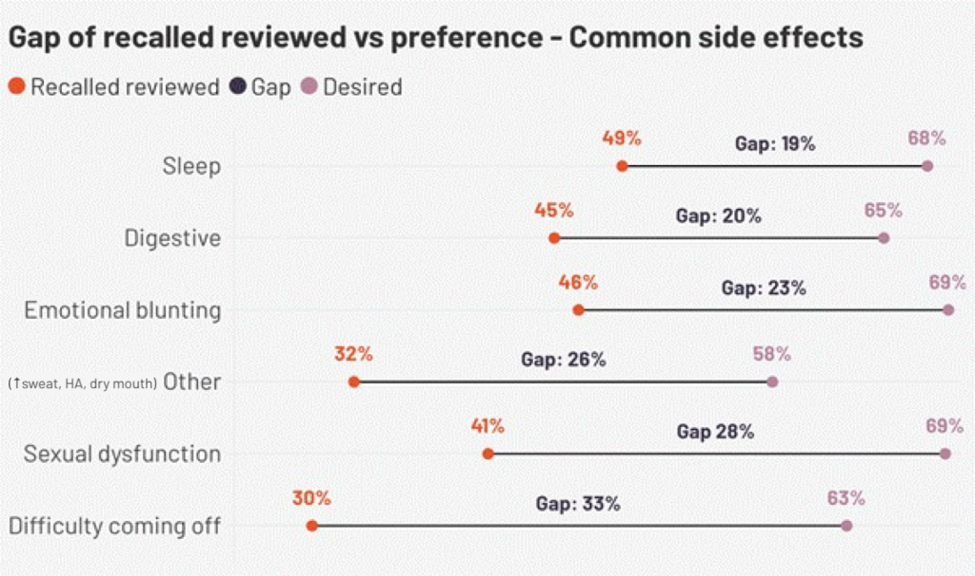
The disconnect widens significantly for less common but serious medical risks – the largest gap in the entire study concerned the risk of bleeding (46%), followed closely by sodium imbalance (44%).
These findings quantify a potential serious failure in the informed consent process. Patients say that they were denied information they value, which means that the current standard of care fails to meet the legal and ethical requirement to disclose “all perils bearing significance” to the patient, as 89% of respondents had at least one preferred side effect left unreviewed.
Conclusion
The primary limitation of this study is that participants were asked to remember what happened during past informed consent conversations. The researchers did not directly observe those conversations. So, the findings show what people remember being told about possible adverse effects, not necessarily everything that was said. This means that the study cannot prove that certain risks were never mentioned.
Still, these findings matter. If people do not remember being told about adverse effects that could seriously impact their quality of life, then the consent process may not have worked as intended, even if the risks were briefly mentioned. Informed consent must involve more than simply listing possible harms. Patients need information that is clear, understandable, and memorable enough to help them make an informed decision.
Informed consent is an ongoing process, not a conversation that ends when the first prescription is written. As treatment continues, patients need opportunities to revisit this information, ask questions, and integrate new information to reconsider choices when their medications, health, or circumstances change.
This Inner Compass Research Institute report reveals a stark contrast between what patients are being told and what information they feel that they need. By no standard is this a sufficient result of our current informed consent processes around SSRIs.
These findings suggest that there is a dire need to move our informed consent process closer to what the patient needs to know to make an informed decision by their own standards of knowledge, which includes being informed of all possible risks, even the more uncommon yet potentially severe risks.
Click here to read the full report and all of the additional findings, including what we found in the research about the effectiveness of antidepressants, what this means for policy, and participants’ opinions and satisfaction with informed consent…
Hereafter referred to as adverse effects to better capture their meaningful prevalence (not “side”) and their unwanted effects
The limitation you flagged at the end is the most interesting part, not a weakness. Recall can't separate "never disclosed" from "disclosed but not retained," and those two failures need opposite fixes, one a disclosure-standards problem, the other a communication-and-documentation one.
But for the patient's actual decision the distinction almost doesn't matter, because what governs the choice is what consent leaves behind, not what was technically said in the room. Measuring retained understanding rather than disclosure might be the more honest endpoint, and your data is pointing right at it.
I am no longer on any psychiatric meds, but I had been on a succession of them for nearly 20 years (Lexapro, Wellbutrin, Pristiq, Lithium, and many more.) I am going to guess that my experience is pretty typical: the doc only brings up how difficult it is to go off of them WHEN YOU ASK TO GO OFF OF THEM. In my last conversation with my doctor, who was retiring, I told him I was discontinuing Wellbutrin. He tried to bully and scare me (my opinion) into staying on it, saying that unmedicated depressed people develop dementia, etc. I think he was offended that I had brought up the book Anatomy of an Epidemic: Magic Bullets, Psychiatric Drugs, and the Astonishing Rise of Mental Illness in America. He had not even heard of it. I told him I was troubled by the rise in mental illness, and noted that when I finally reflected on my life, I realized that I wasn't getting better on any medication. Since then, I've started walking every single day, especially in the woods, exercising with weights every single day, and I eat a mostly healthy plant diet. It has helped more than any pill ever did.